The real cost of help desk outsourcing: a marketing leader’s guide to budget and ROI

Help desk outsourcing costs run $8 to $60 per hour, or $6 to $40 per ticket, depending on where the team sits and how complex the tickets are. A dedicated agent runs roughly $900 to $4,500 per month. Your final number tracks volume, support tier, coverage hours, and SLA targets.
If you own a support budget, two questions matter: where the money goes and what you get back. This guide breaks down help desk outsourcing costs by pricing model, region, and support tier, then compares those numbers to the cost of running the same desk in-house. You’ll walk away with a budget you defend and an ROI case your CFO will sign.
What is help desk outsourcing?
Help desk outsourcing means hiring an external provider to run your technical and customer support: answering tickets, resolving issues, and handling escalations on your behalf. Companies outsource to cut fixed payroll, reach 24/7 coverage without running night shifts, and scale agent headcount up or down as ticket volume moves.
The model fits two situations well. First, when support volume swings with seasons, product launches, or growth, and a fixed in-house team either sits idle or drowns. Second, when you need specialized coverage, such as multilingual, after-hours, or regulated-industry support, faster than hiring it in-house would allow. You keep ownership of strategy and quality standards; the provider runs the day-to-day desk against the targets you set.
How much does help desk outsourcing cost?
Help desk outsourcing costs run $8 to $60 per hour, $6 to $40 per resolved ticket, or roughly $900 to $4,500 per dedicated agent per month. Where you land inside that spread comes down to geography, support tier, and how you buy: by the hour, by the ticket, by the agent, or by the user.
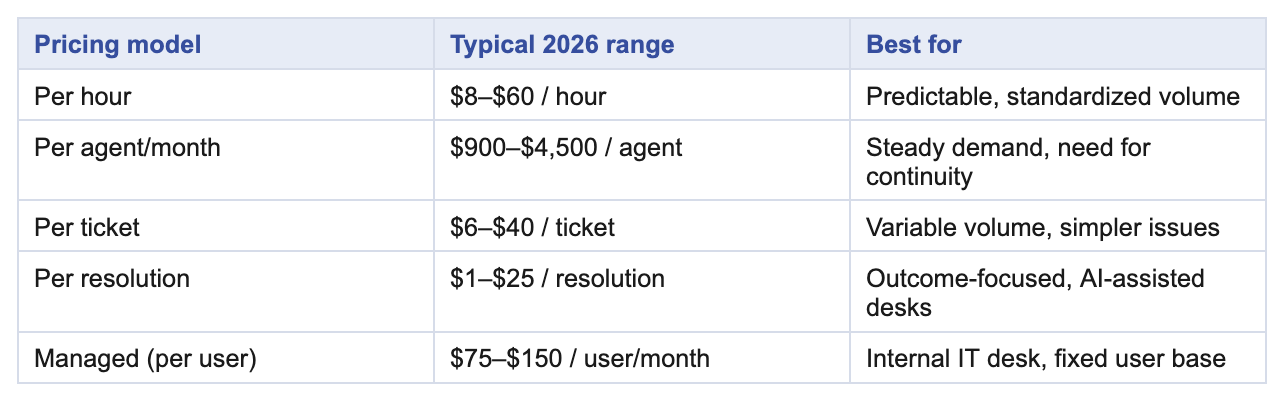
Two forces move your number inside this range. Geography sets the floor: an offshore agent in the Philippines costs a fraction of an onshore agent in the United States. Complexity sets the ceiling: a password reset (Tier 1) costs far less per ticket than an infrastructure escalation (Tier 3), which starts around $40 and climbs. Most outsourced desks concentrate on Tier 1 and Tier 2 work, which absorbs 70 to 80 percent of typical volume.
What factors affect help desk outsourcing costs?
Seven variables drive the gap between a $9 hour and a $55 one.
Geographic location
Location drives the single largest swing in your rate. Offshore delivery in the Philippines or Eastern Europe runs $8 to $16 per hour. Nearshore options in Mexico or Latin America land around $18 to $30. Onshore agents in the United States or Canada command $28 to $50 or more. The tradeoff is timezone alignment, accent, and native-language fluency against raw hourly cost.
Support tier
The depth of technical skill you need sets the price per ticket. Tier 1 handles password resets, account access, and basic how-to questions at the low end of every range. Tier 2 troubleshoots software and configuration issues. Tier 3 covers infrastructure, API, and engineering-level escalations, starting near $40 per ticket and rising with complexity. Most engagements blend tiers, routing the bulk of volume to Tier 1 and reserving senior agents for escalations.
Support channel
Voice costs more than chat or email. Phone support needs more agents per ticket and longer handle times, so voice-heavy desks price higher than omnichannel desks weighted toward chat, email, and self-service. Routing repetitive questions to a chatbot or knowledge base trims the live-agent load and the bill with it.
Team model
A dedicated agent works only your queue and learns your product; a shared agent splits time across several clients. Dedicated teams cost more per hour but give you continuity, product depth, and tighter quality control. Shared or pooled models cost less and flex faster, which fits low or unpredictable volume.
Coverage hours
Business-hours coverage is the baseline. Extending to 24/7 adds night and weekend shifts, premium pay, and a larger roster, which lifts your monthly cost. A global provider with delivery centers in multiple timezones runs round-the-clock coverage during local daytime hours, which costs less than paying overnight differentials in one location.
SLA targets
Tighter service-level agreements cost more. A two-minute answer time and a four-hour resolution target need more staff on standby than a next-business-day SLA. Penalty clauses and guaranteed CSAT thresholds raise the provider’s risk, and price it in. Match your SLA to what the business needs, not the strictest number on the menu.
Volume and contract length
Volume cuts your unit price. Higher ticket counts and longer contracts earn lower per-ticket and per-hour rates, because the provider amortizes onboarding and training across more work. Watch the flip side: many contracts set minimum monthly volumes, so a quiet month still bills at the floor.
Help desk support pricing models explained
Five pricing models dominate outsourced help desk pricing in 2026, and the right one aligns the provider’s incentives with yours. Helpware bills three ways: subscription (monthly), per hour, and per transaction, so the structure matches how your volume behaves. For a side-by-side of providers and their rates, see the Helpware roundup of help desk outsourcing companies.
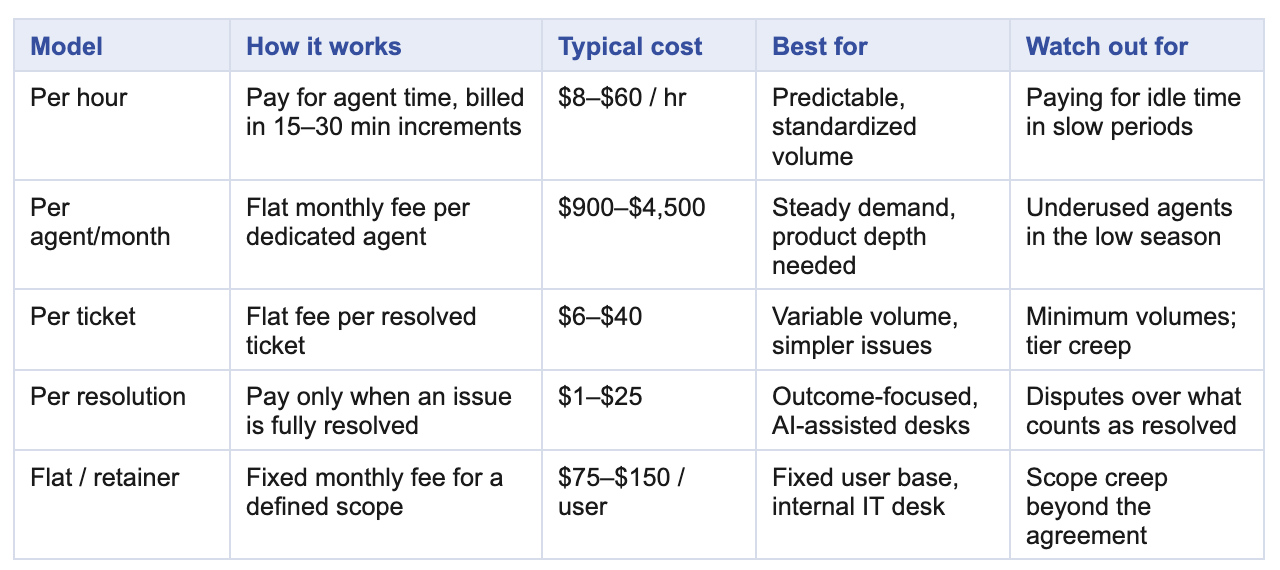
Per-ticket pricing is the most popular outsourced model, and the most transparent. You pay a flat fee, $6 to $40, for each resolved ticket, with simple Tier 1 tickets at the low end and complex escalations at the top. It works best when volume swings month to month and most issues are straightforward. The risk is tier creep: a contract priced on simple tickets gets expensive when complex ones pile up.
Per-agent pricing suits steady, specialized demand. You pay a flat monthly fee, roughly $900 to $4,500, for a dedicated agent who learns your product and owns your queue. It costs more than a shared pool but buys continuity and deeper product knowledge. The rule of thumb: choose per ticket when volume is variable and issues are simple, and per agent when demand is steady and context matters.
Help desk outsourcing cost by location
Where your team sits shapes your budget more than any other single decision. Offshore is not a quality discount; it is a cost-structure choice. The best providers run high-CSAT desks from offshore centers by investing in training, QA, and accent-neutralization technology. The real tradeoff is timezone overlap and language coverage against hourly rate.
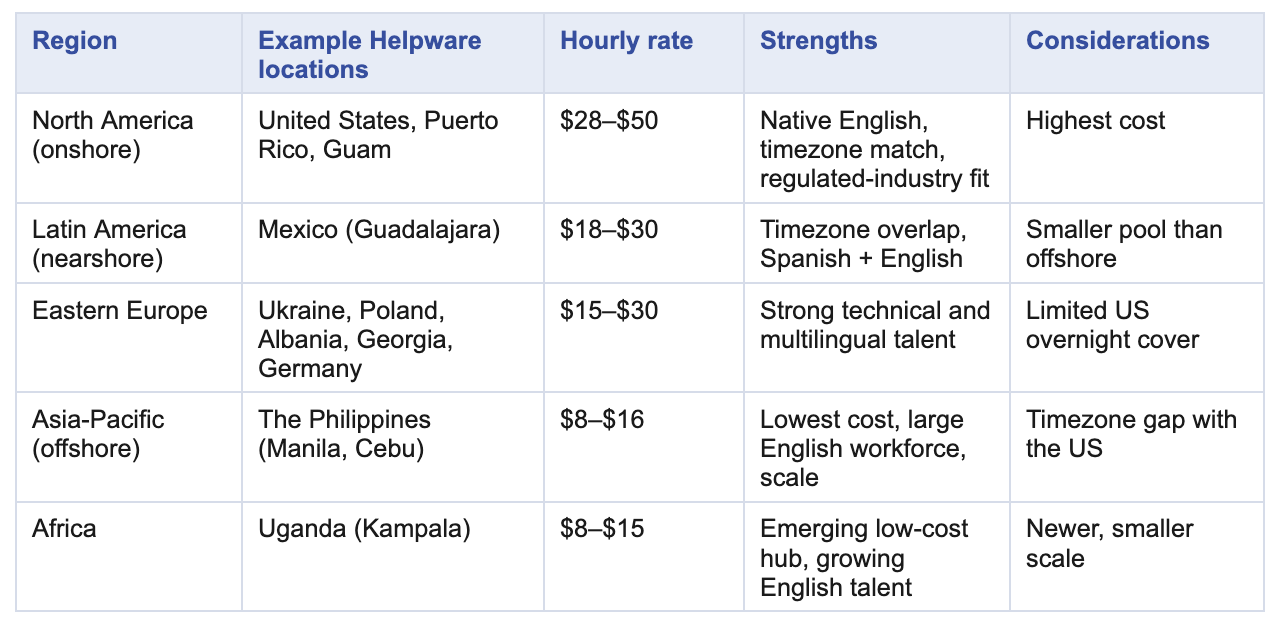
Helpware runs help desk operations from 19 locations across 11 countries and 4 continents, in 45+ languages. Clients blend onshore, nearshore, and offshore agents to hit their own balance of cost, language coverage, and timezone overlap. Its Uganda center is one of the few mid-market BPO operations in Africa, an emerging option for cost-efficient English support.
In-house vs outsourced help desk: cost comparison
Salary is the visible cost of an in-house desk; the loaded cost runs 1.5 to 1.7 times higher. Add benefits, payroll taxes, recruiting, training, tools, management, and facilities, and a single United States help desk agent costs $90,000 to $100,000 a year. The numbers below set the loaded cost against an outsourced equivalent.
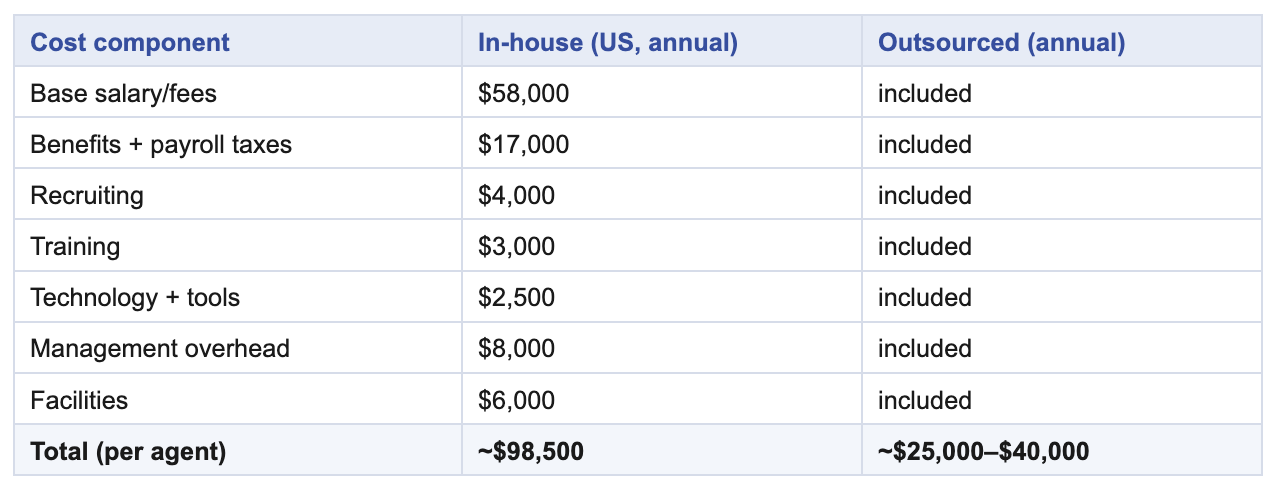
At a small scale, in-house wins. One part-time person handling a few tickets a day costs less than a contracted minimum. The math flips fast. Once you need more than one full-time agent, or your monthly ticket volume clears a few hundred, the per-unit economics of outsourcing pull ahead, because the provider spreads management, tools, and facilities across many clients.
Compare the total cost of ownership (TCO), not the headline hourly rate. The provider rate already absorbs the overhead that inflates an in-house desk. Above the break-even threshold, an outsourced desk runs 40 to 60 percent cheaper than the in-house equivalent, a figure Helpware reports across its client base.
How to reduce help desk outsourcing costs
Six ways to cut the bill without cutting service quality:
- Blend your tiers. Route Tier 1 volume to a shared or offshore pool and reserve dedicated senior agents for escalations only. A blended rate beats paying senior prices for password resets.
- Deflect repetitive tickets with self-service. A solid knowledge base and a chatbot absorb common questions before they reach a live agent. AI-augmented desks cut handling costs 20 to 30 percent, a range Helpware reports across its automation deployments.
- Match coverage to demand. Pull ticket data by hour and day, then staff to the real curve instead of buying a flat 24/7 you don’t need.
- Negotiate on volume and term. Commit to a longer contract or a higher volume tier in exchange for a lower per-unit rate, and cap minimum-volume penalties before you sign.
- Pick the right pricing model. Variable volume favors per-ticket; steady demand favors per-agent. The wrong model leaves you paying for idle capacity or eating overage fees.
- Audit the invoice monthly. Track cost per resolved ticket, not total spend alone, and watch for tier creep, idle-time charges, and scope additions that inflate the bill.
What to look for in a help desk outsourcing partner
Price is one input. The partner you pick decides whether outsourcing saves money or costs more through churn, missed SLAs, and rework. Run any shortlist against this checklist:
- Transparent, flexible pricing: no hidden setup fees, idle-time charges, or surprise minimums.
- Language and cultural fit: native or near-native coverage in the languages your customers use.
- Technology and CRM integration: works with your stack, from Zendesk and Salesforce to your ticketing system.
- Industry experience: agents who already understand your sector and its workflows.
- SLA guarantees and reporting: clear targets, penalty clauses, and real-time dashboards.
- Scalability: the capacity to grow from a pilot to hundreds of agents without a quality drop.
- Security and compliance certifications: SOC 2, ISO 27001, HIPAA, and GDPR for regulated data.
Frequently asked questions
How much does help desk outsourcing cost per month?
A small outsourced help desk starts around $2,000 to $5,000 per month for part-time or shared coverage. A single dedicated agent runs $900 to $4,500 per month, depending on location, with offshore at the low end and onshore in the United States at the top. A larger team with 24/7 coverage and tight SLAs scales into five figures monthly. Your number tracks agent count, location, coverage hours, and support tier.
Is per-ticket or per-agent pricing cheaper?
It depends on your volume pattern. Per-ticket pricing ($6 to $40 per ticket) costs less when volume is variable and most issues are simple, because you pay only for work done. Per-agent pricing ($900 to $4,500 per month) costs less per unit once volume is high and steady, because a dedicated agent clears more tickets per dollar than metered pricing. Map a typical month before you choose.
Which hidden costs appear in help desk outsourcing contracts?
Five line items inflate outsourced help desk costs beyond the headline rate: one-time setup fees ($1,500 to $5,000 for Tier 1), minimum monthly volume commitments, idle-time charges on hourly contracts, SLA penalty mechanics, and tier creep. The last one bites when simple-ticket pricing meets complex tickets. Ask for an itemized quote and a sample invoice before signing, and cap minimums in the contract.
How much do I save by outsourcing versus hiring in-house?
A fully loaded in-house help desk agent in the United States costs $90,000 to $100,000 a year once you add benefits, recruiting, training, tools, management, and facilities to the base salary. A dedicated outsourced agent runs $25,000 to $40,000 a year, with the provider absorbing that overhead. Above a modest volume threshold, outsourcing runs 40 to 60 percent cheaper than in-house, a figure Helpware reports across its client base.
How fast does an outsourced help desk scale for peak season?
A capable provider scales a help desk in weeks, not months. Helpware grows client teams from a pilot to 500+ agents in 90 to 120 days, with training and QA built into the ramp. For seasonal peaks, agree on a flex-capacity clause up front, so you add agents for the holiday or launch window and release them after, without renegotiating the whole contract.
Does offshore help desk support cost less because quality is lower?
No. Offshore rates ($8 to $16 per hour) reflect local labor costs, not service quality. Leading offshore desks run high-CSAT operations through structured training, quality assurance, and tools like accent-neutralization and real-time coaching. Quality tracks the provider’s standards and management, not the map. The genuine tradeoff is timezone overlap and language coverage, which you solve by blending offshore agents with nearshore or onshore coverage where it counts.
What compliance certifications matter for an outsourced help desk?
For regulated data, require SOC 2 Type II at a minimum. Healthcare desks need HIPAA compliance; any operation touching European customer data needs GDPR; ISO 27001 and ISO 9001 signal mature security and quality systems. A provider handling payment or health information without these certifications is a liability, not a savings. Helpware holds SOC 2 Type II, ISO 27001, ISO 9001, HIPAA, and GDPR across its delivery centers.
How do I budget for help desk outsourcing?
Start with volume. Pull your monthly ticket count and average handle time, then multiply by a blended rate for your target region and tier. Add one-time setup ($1,500 to $5,000) and a buffer for peak months. For a quick estimate: 1,000 monthly tickets at a blended $12 per ticket runs about $12,000 a month, plus setup. Refine the model with a provider quote before you commit to the budget.